Context
Role
Product Designer
Team
1 Product Designer
duration
2 months
Skills
UI/UX
Research
Branding
Prototyping
Challenge
Exchange apps hold real potential for learners without access to immersion, yet education apps typically retain only 2-3% of users by day 30 ². In collaboration with Johnson Luong (fellow language learner and product designer), I set out to understand why these apps fail, and how thoughtful design and modern tools could support a more sustainable practice.
“I want to practice speaking, but I can't find the right people to practice with. Many interactions feel intimidating or unhelpful.”
“Learning a new language is overwhelming, and I'm unsure where to start. Existing apps feel bloated or irrelevant to my needs.”
1 / 4
Getting set up on Bubble
Bubble’s onboarding balances gathering only essential information for quality matches, while respecting user privacy. Playful visuals making the process feel engaging rather than tedious, and a waitlist at the end builds community trust through manual human review.
2 / 4
Find the right practice partner, not just more of them
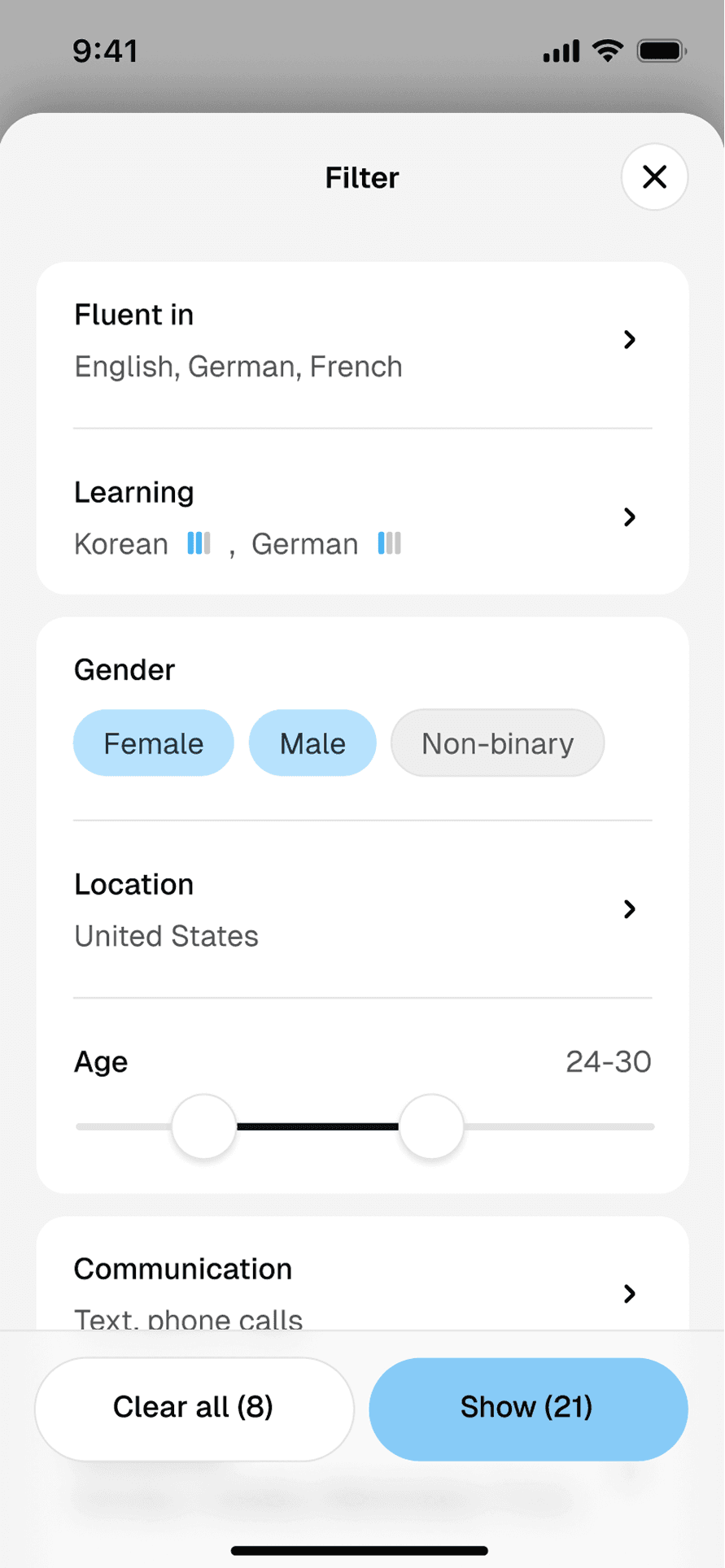
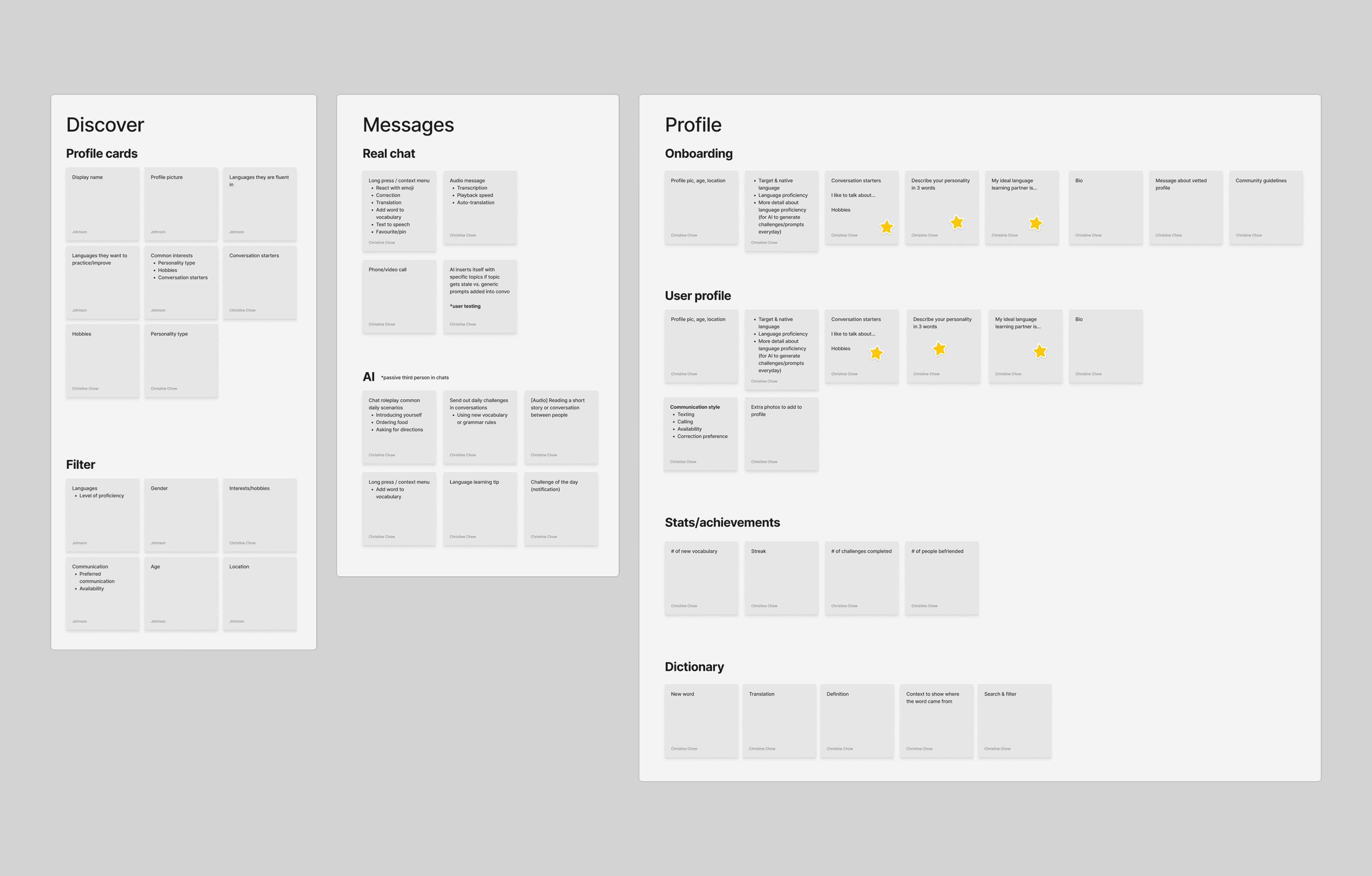
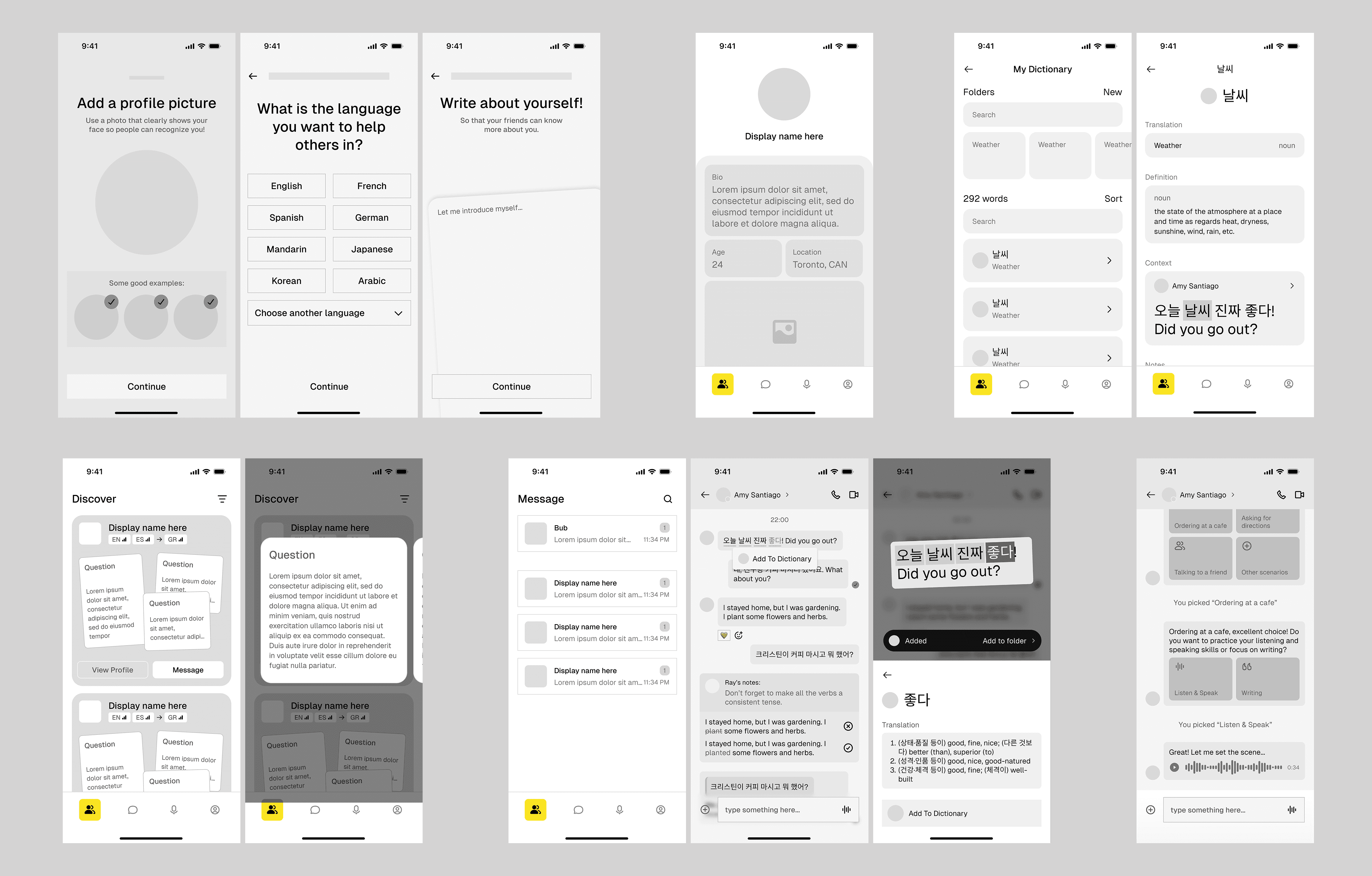
A thoughtful matching algorithm and filters helps surface profiles with shared interests, goals, communication styles, and desired timezones and proficiency levels. Profile cards are designed larger for slower, thoughtful browsing and contain visual indicators of compatibility to reduce decision fatigue and encourage meaningful conversations.

Discover
Filter
Profile
3 / 4
Focussed, context-driven tools
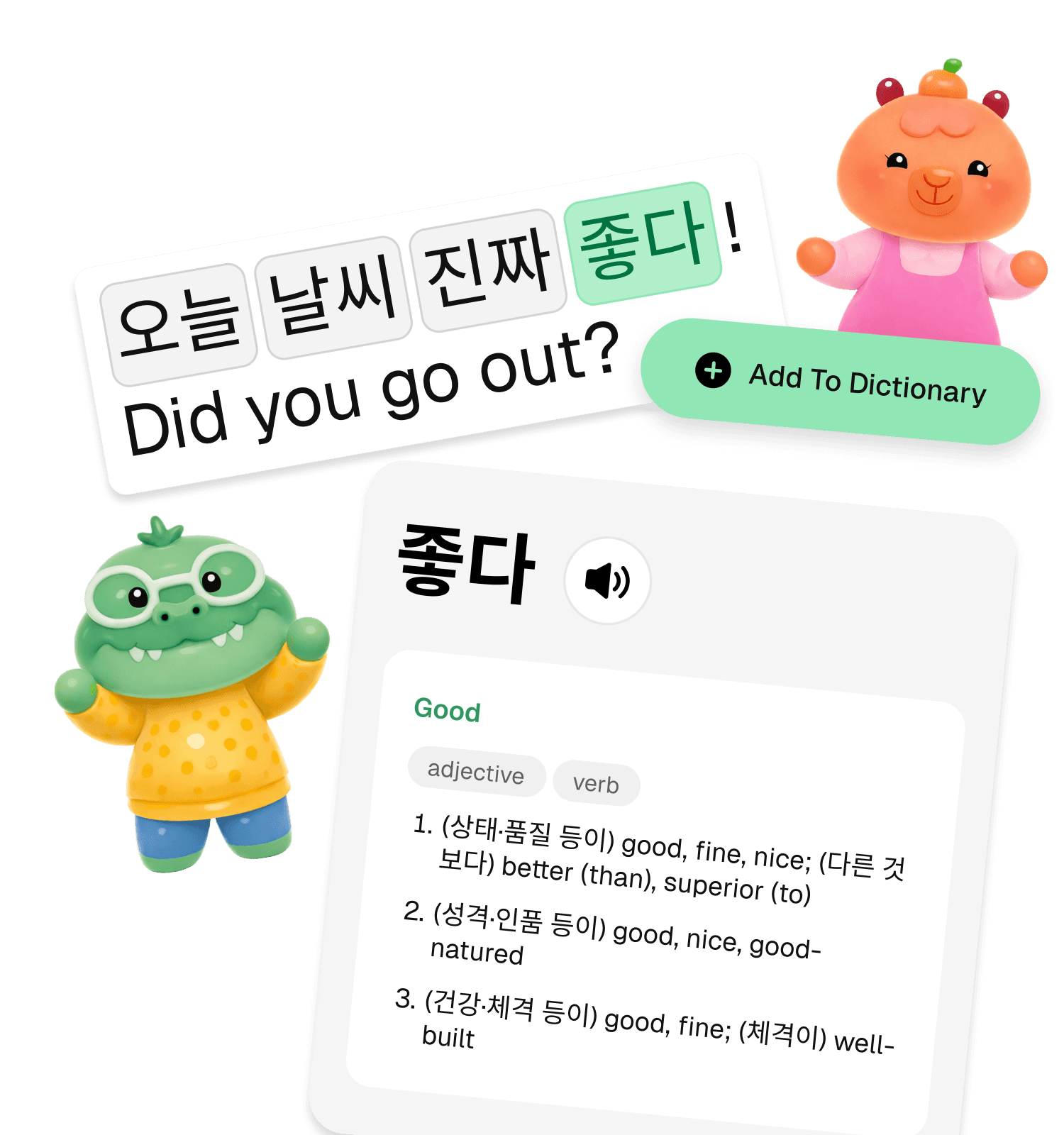
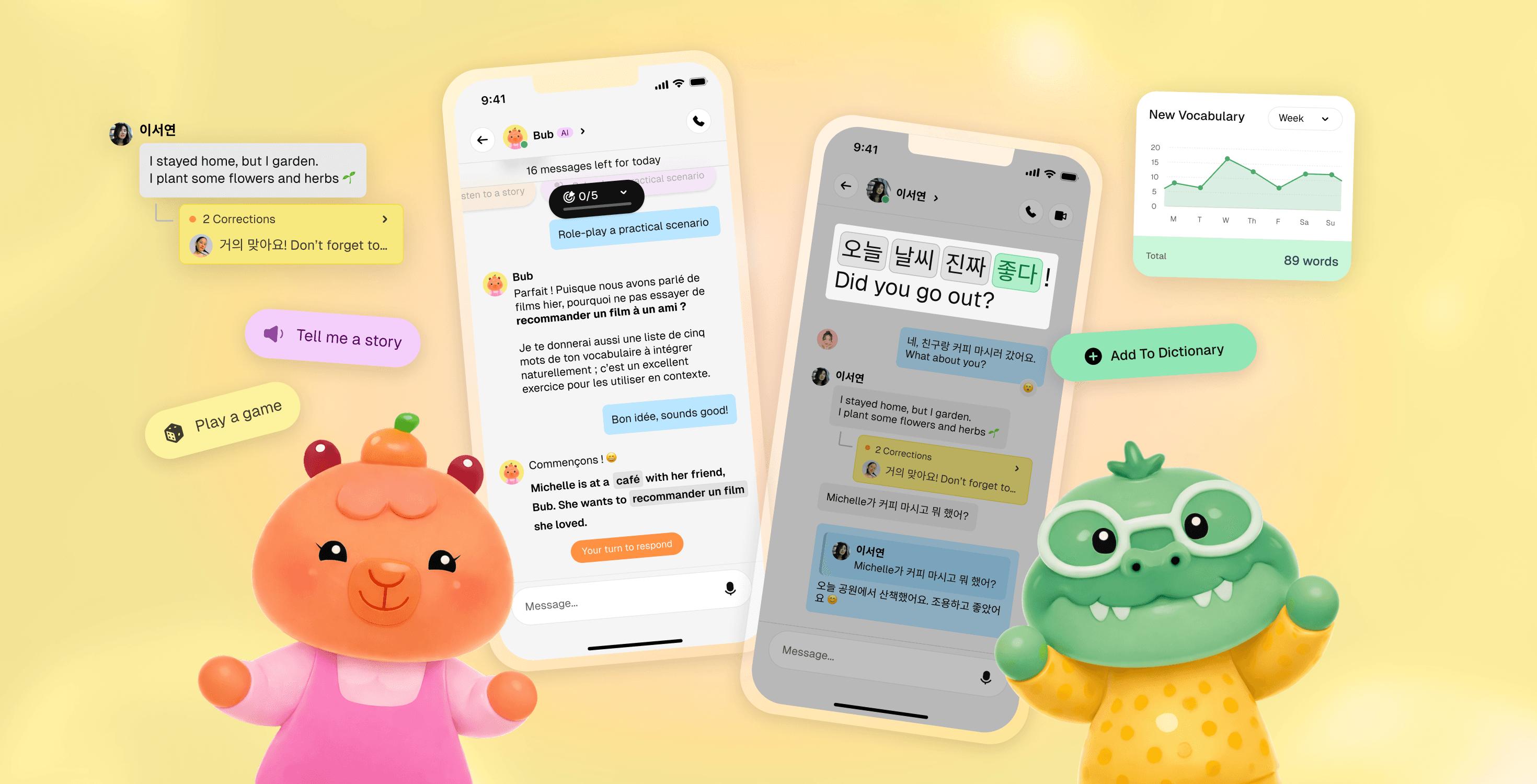
Built-in translation and correction tools let learners help each other during conversations, while vocabulary can be saved directly from messages into a personal dictionary — reinforcing retention through real-world context rather than isolated memorization.
Correction
Personal Dictionary
4 / 4
Need extra support and personalization?
Our AI-powered best friends, Bub and Lee, offer personalized practice that meets learners exactly where they are in their journey.
Bub is available 24/7 as a low-pressure practice partner, perfect for warming up before chatting with real people.
*Daily message limits keep the focus on real human connections.
During conversations, Lee can be called on to help break the ice or support the flow of conversation through activity.
Together, Bub and Lee work behind the scenes to create a Progress dashboard: keeping learners motivated while turning mistakes into mastery through contextualized practice.
Research & Objectives
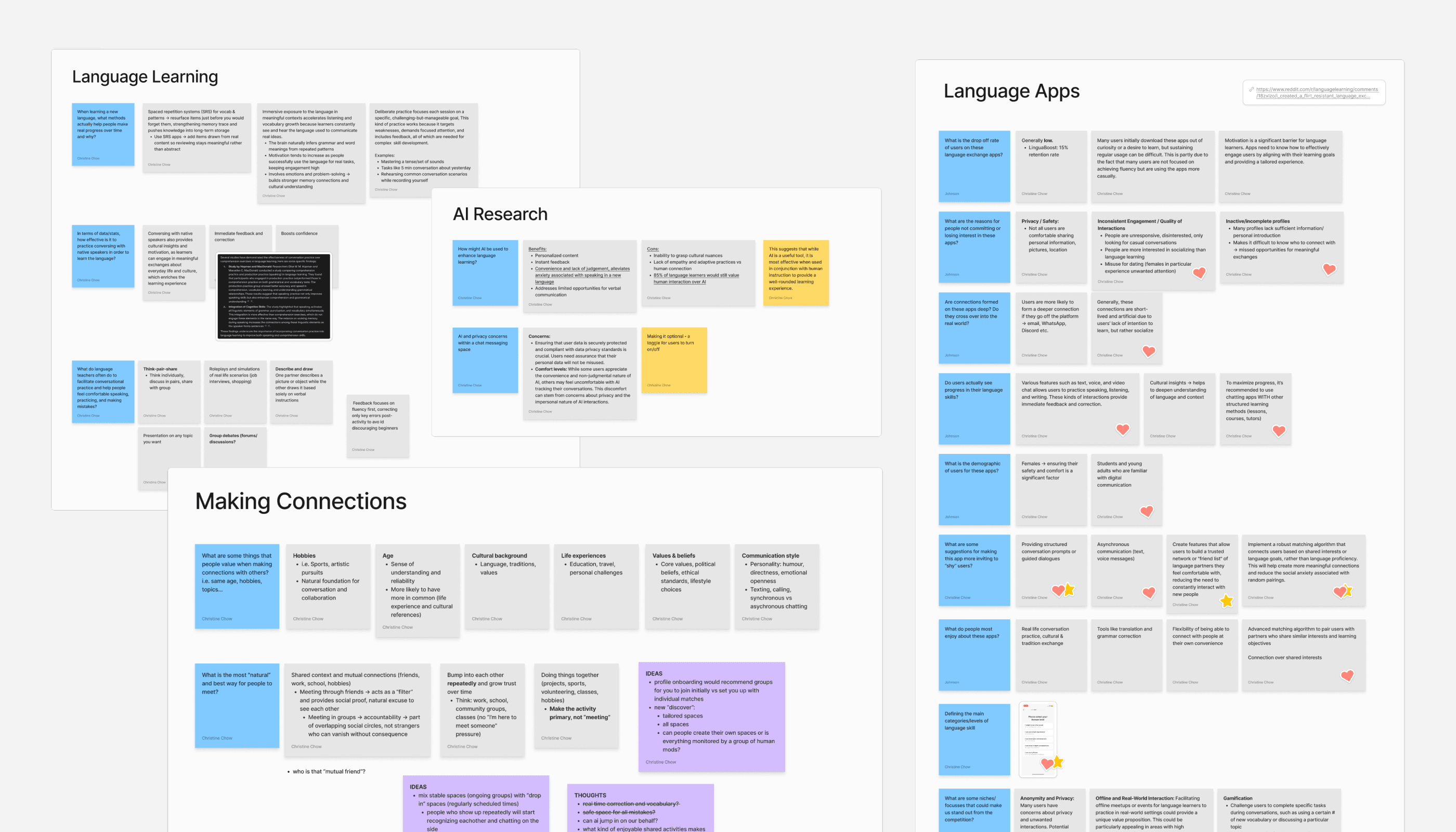
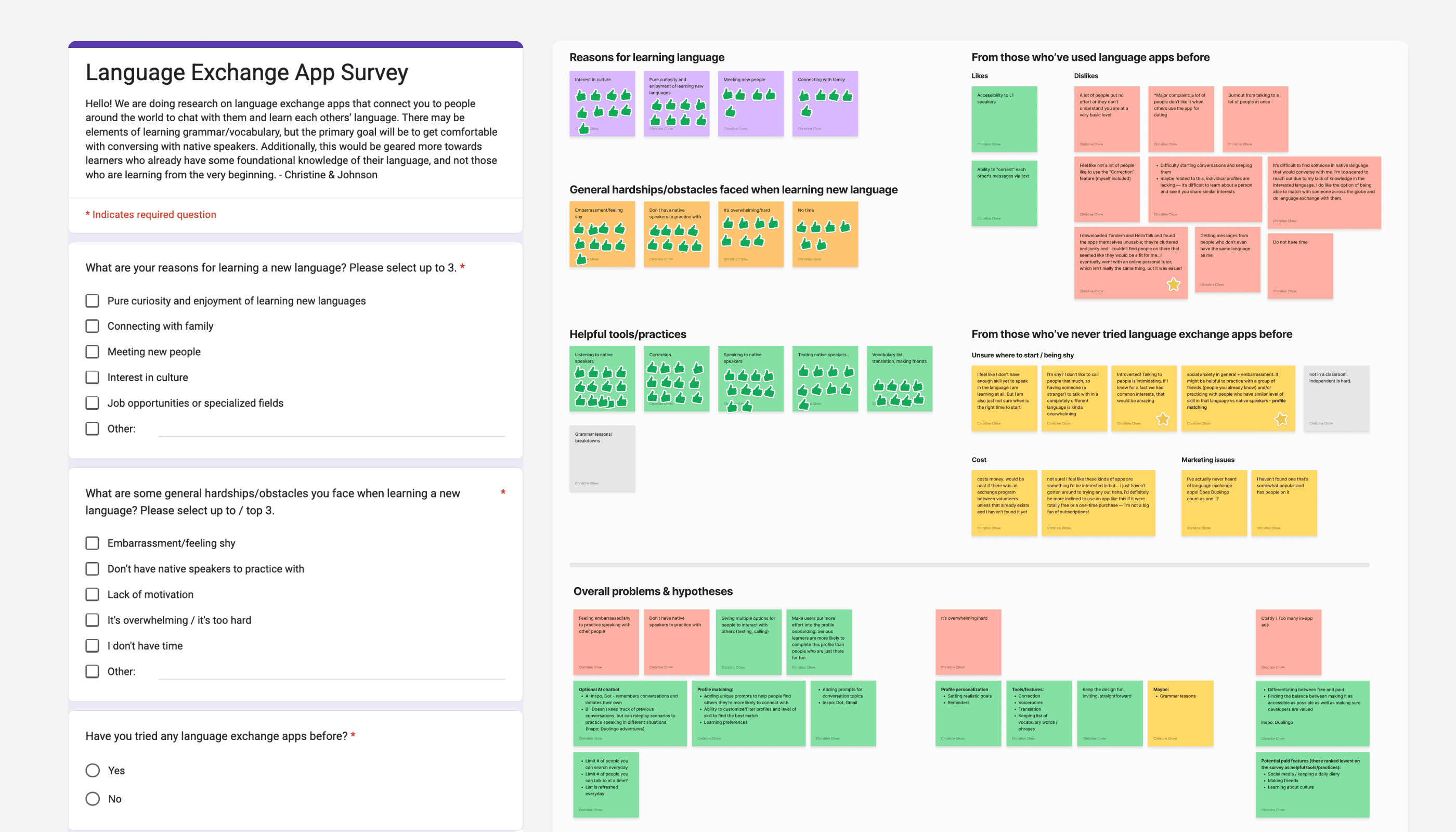
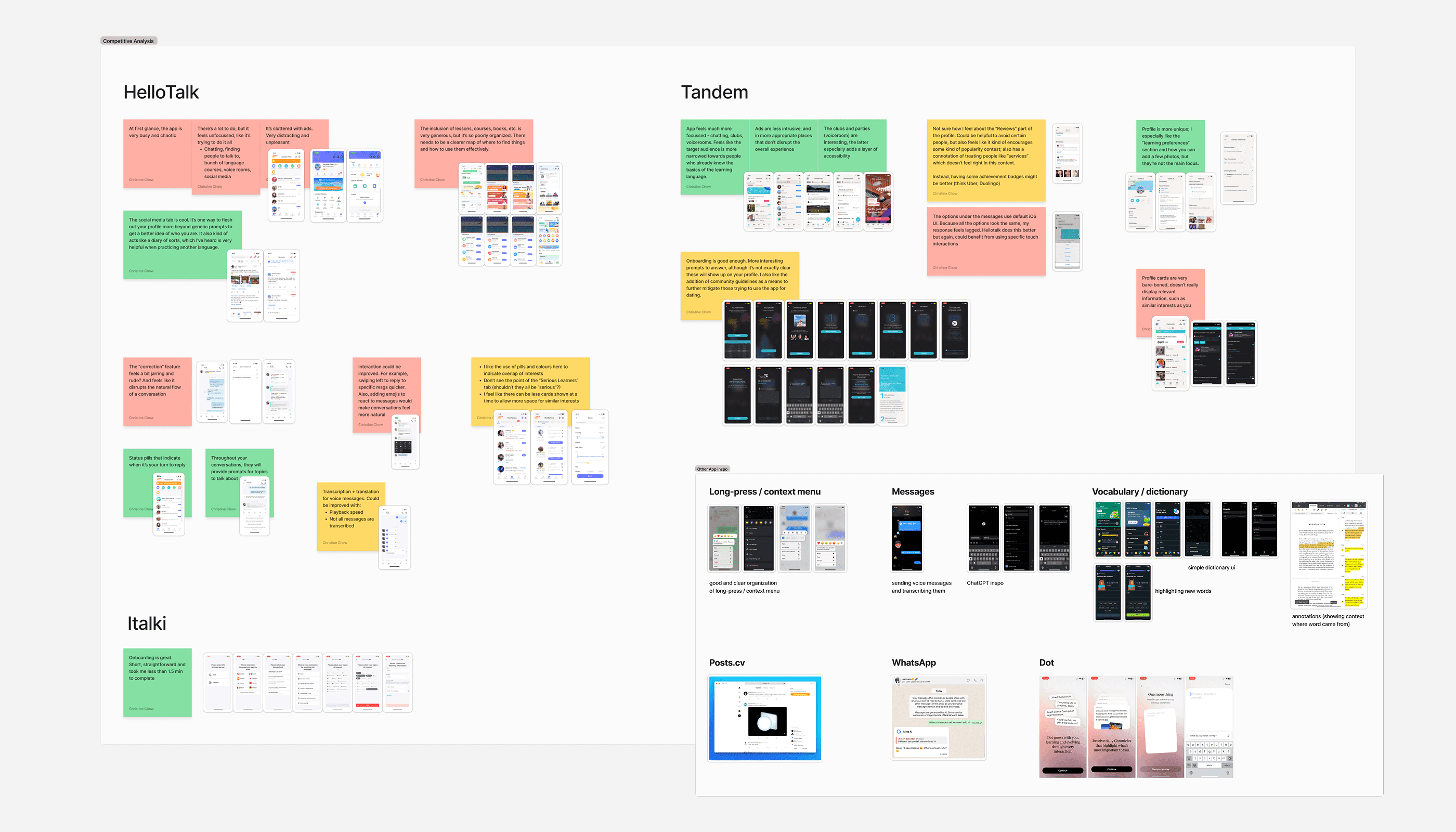
With all this research in mind, we scoped out the key 4 objectives we wanted to achieve for this project:
Provide a focussed and personalized experience with conversation-related features
Balance profile personalization for matching with privacy and security
Facilitate quality matches and encourage intentional browsing
Support an unbiased, non-judgemental, low-pressure environment
Explorations
We kept branding lightweight to keep the sprint focussed on research and UX. A quick moodboard helped align us early on a visual direction with a bright, colourful palette that felt fun, welcoming, and modern. I also hand-drew the mascots, then transferred them to ChatGPT to apply a soft, bubbly texture that matched the logo and overall “bubbly” vibe.
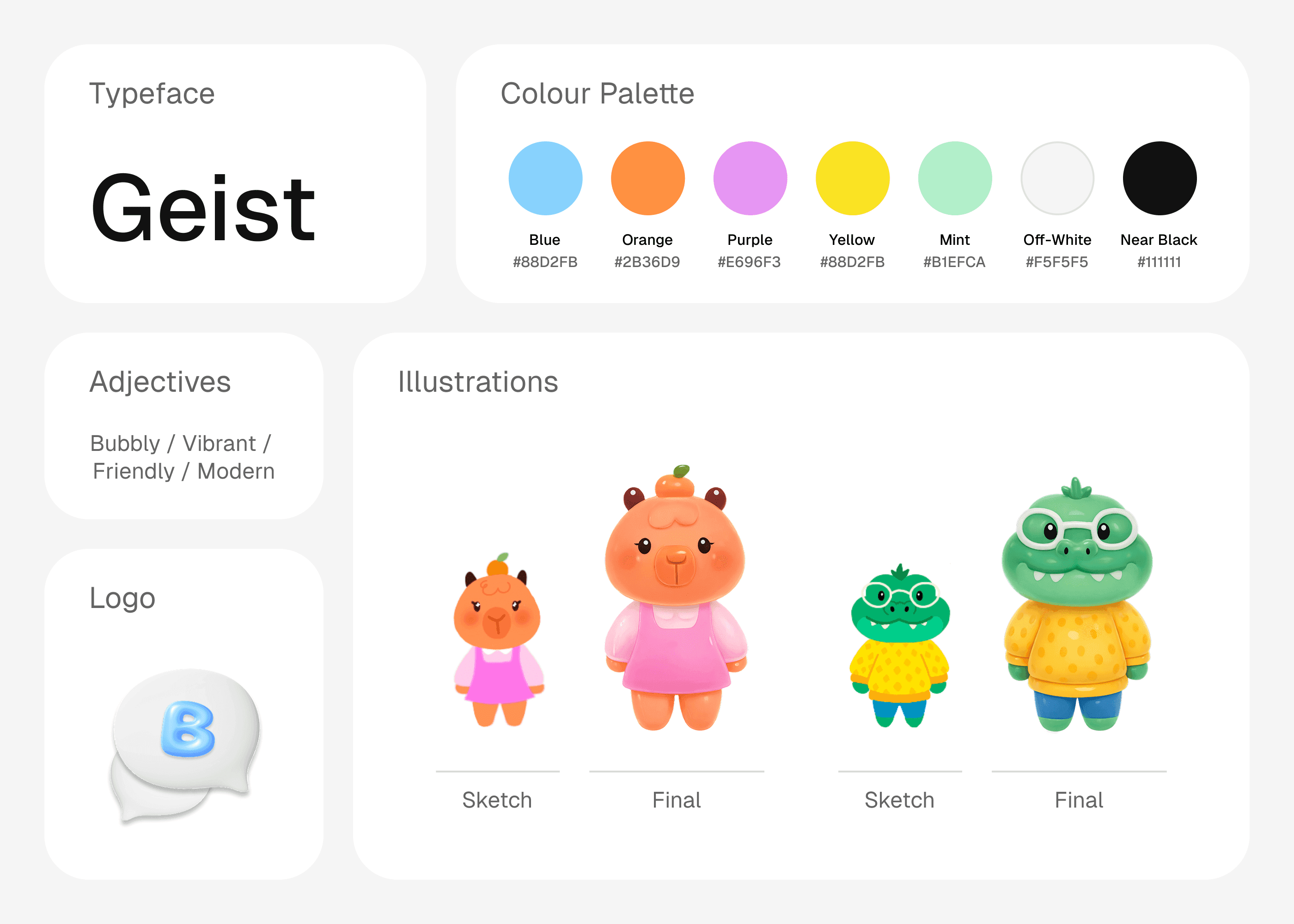
Fun Fact: Our capybara and alligator mascots were inspired by a viral meme. The idea of two different species becoming friends felt like a fun metaphor for breaking language barriers (plus it made us laugh).
User Testing & Revisions
I conducted interviews with 4 participants and observed how they moved through prototypes without hotspots. Their diversity in language journey, occupation, tech familiarity (particularly around AI) provided valuable across visual, design, concept, and usability.
Occupation: Designers, Technical, Non-technical
Interaction Style: Extravert, Introvert
Learning Interest: Serious, Casual
AI Disposition: Regular User, Skeptic, Neutral
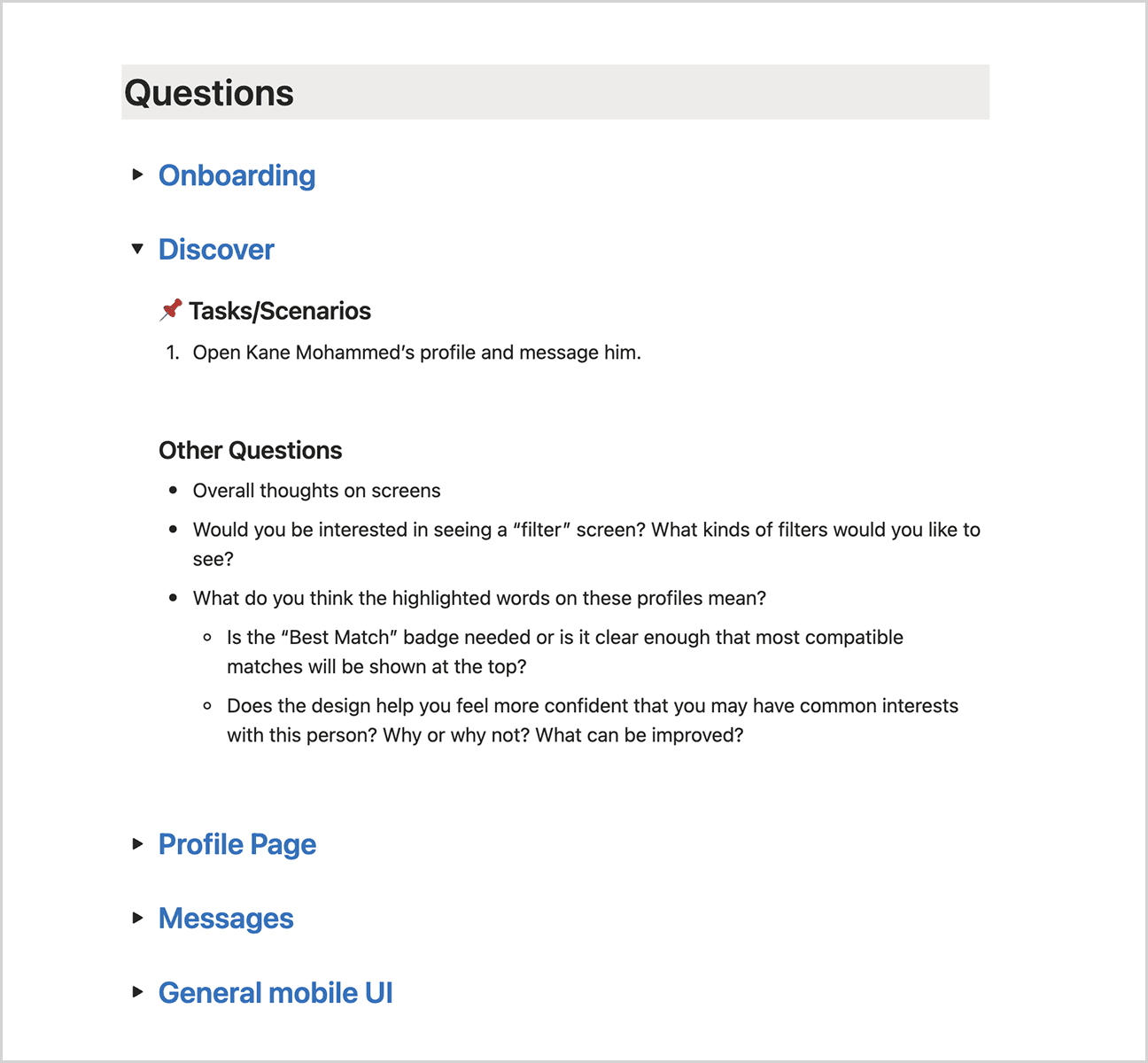
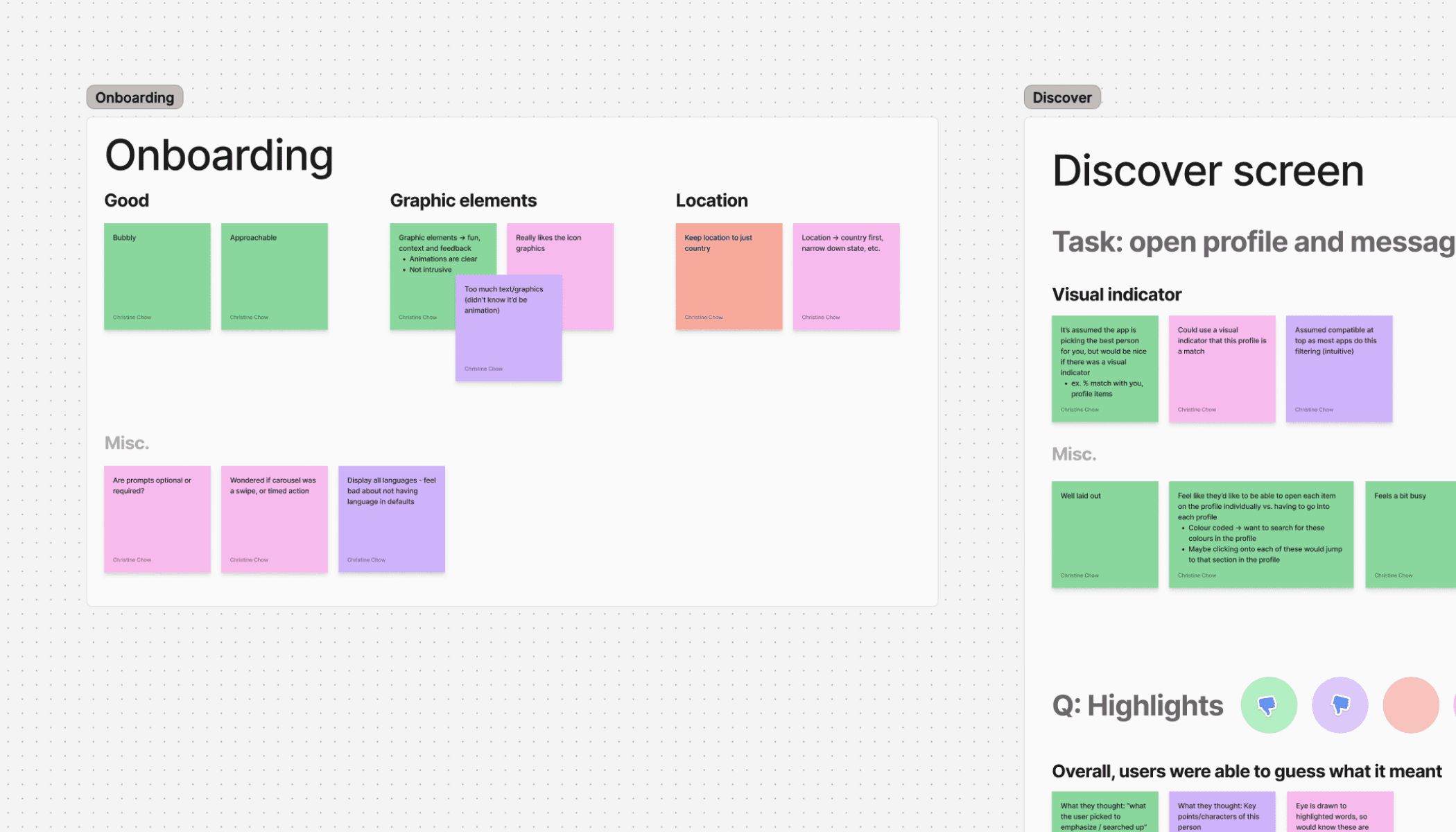
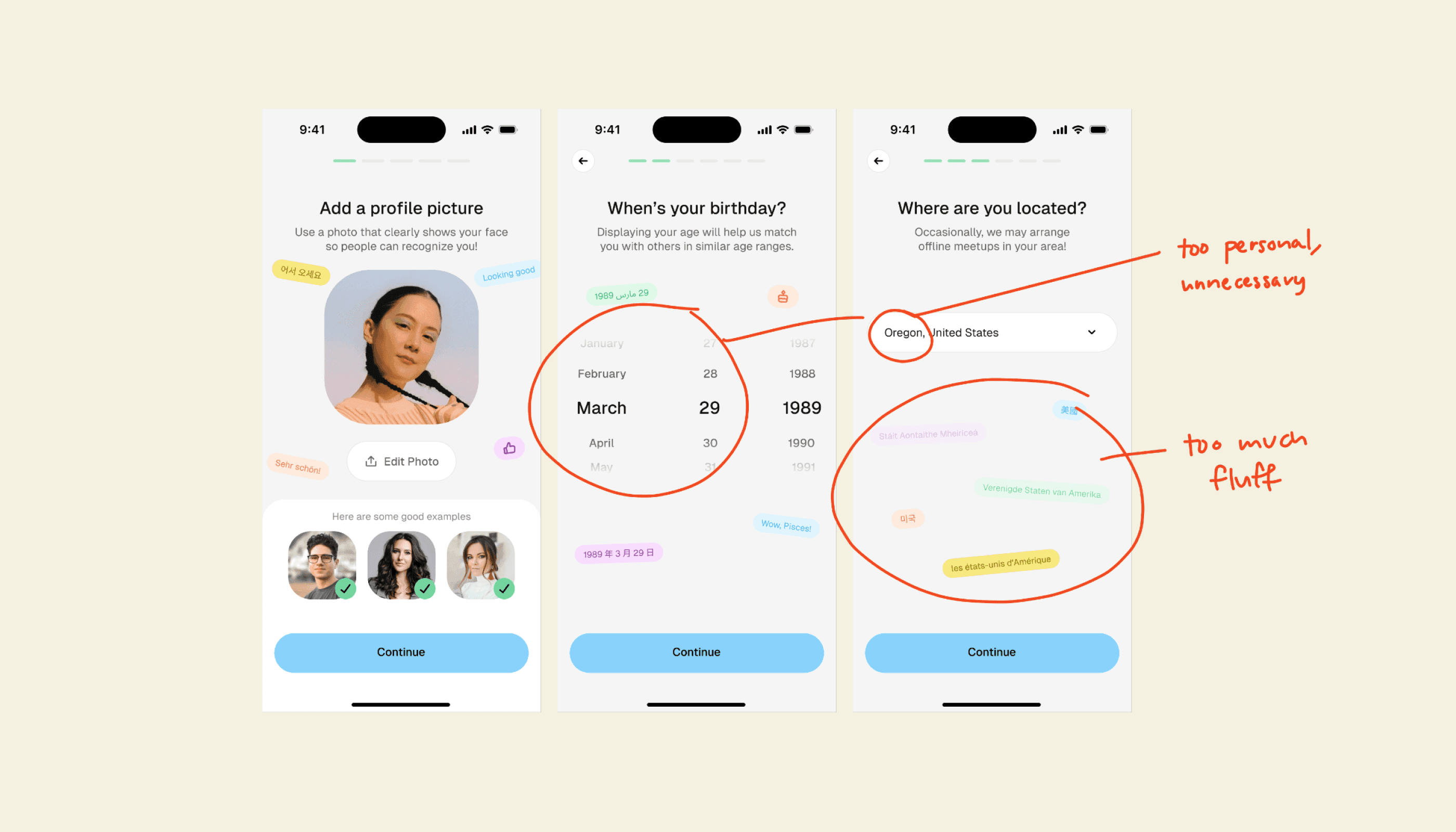
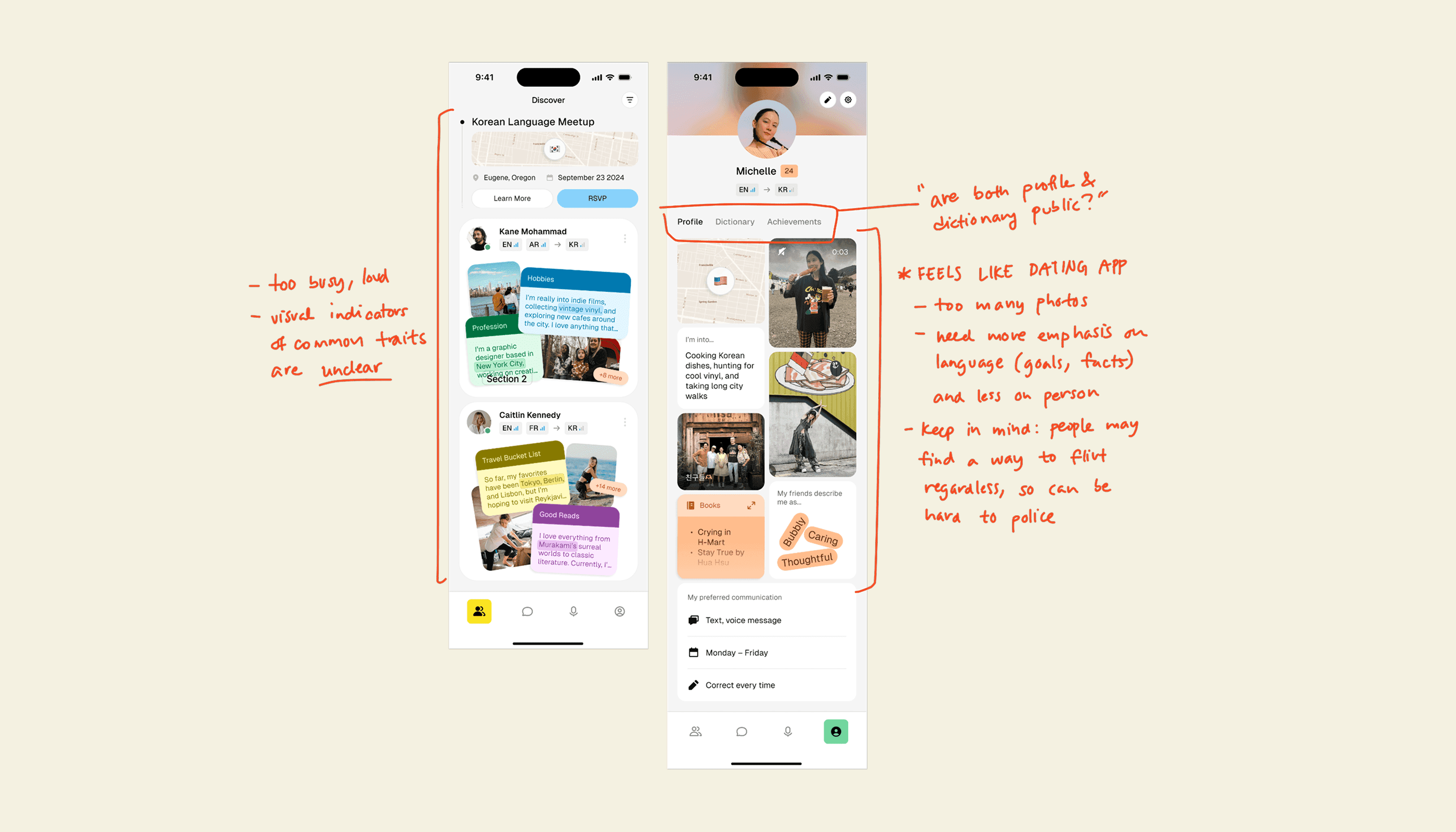
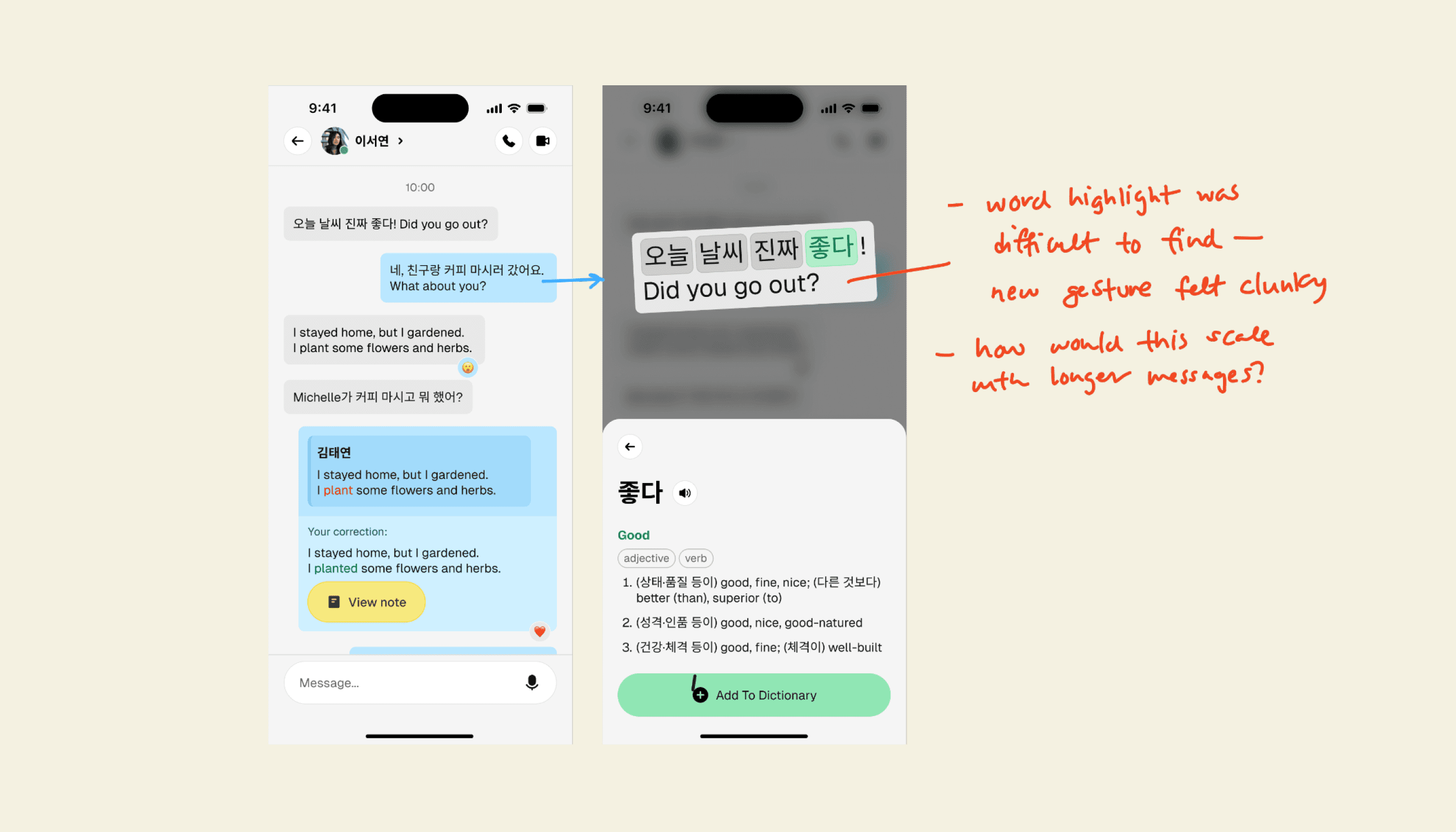
Image: Outline of testing questions and consolidated feedback.
When it came to AI application, our participants reacted positively to the ideas of robust profile matching and a personal chatbot. While these features help start conversations, we felt we were missing something to continue them.
An idea that came up was a "third-party" AI bot that could offer support like topic suggestions, private clarifications, and game facilitation to help with awkwardness in live conversations. Participants had mixed reactions, with main concerns being consent an privacy, disruption of natural conversation flow, inauthenticity, and cultural blindness. We kept game facilitation because users still stayed in control, but access to specific message data felt intrusive.
The pivot: progress over prompts
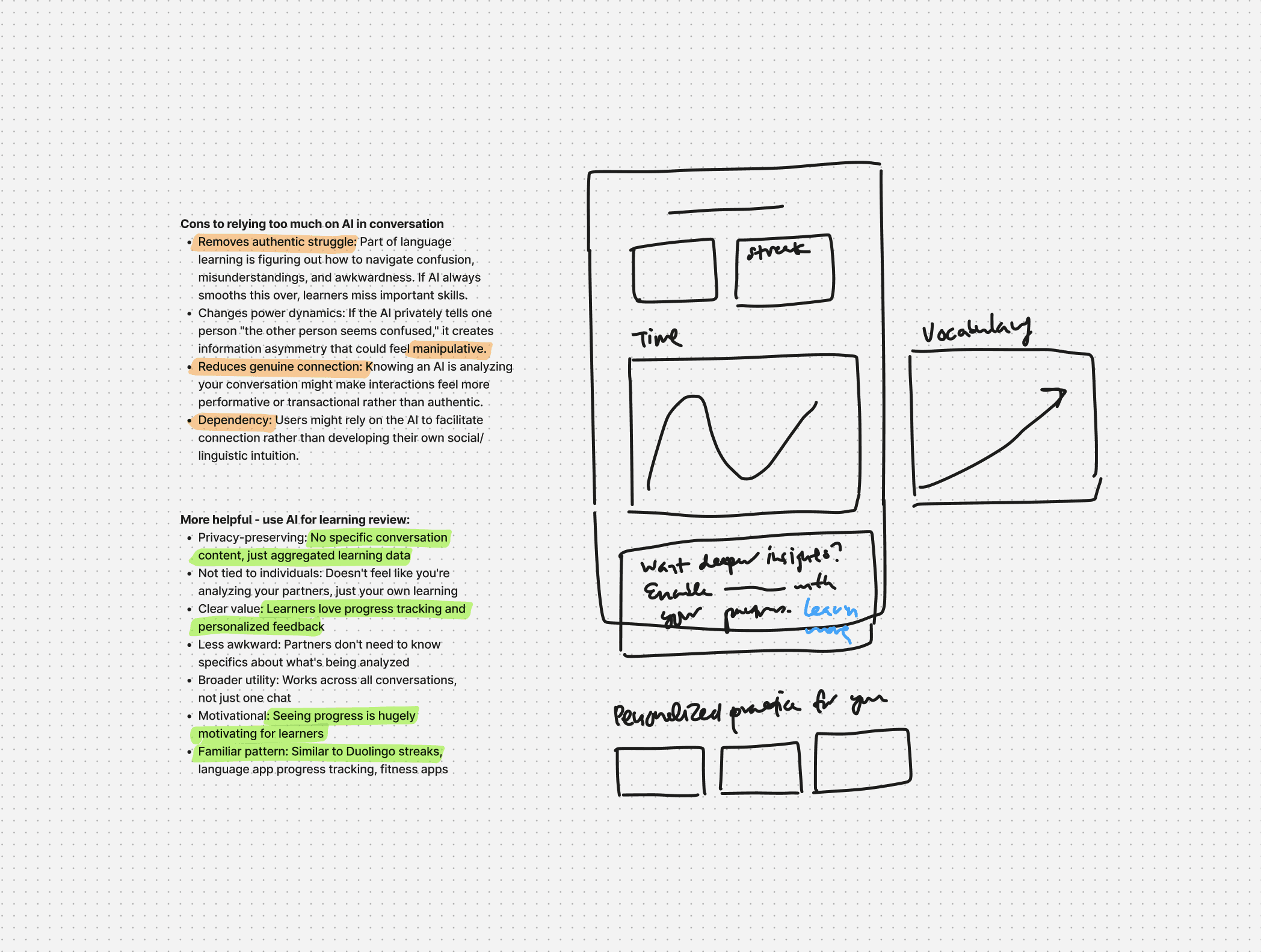
Image: Additional research and sketches for my epiphany.
While revisiting my survey responses, one particular insight stood out:
“having some kind of indication of progression…duolingo is too gamified, doesn't teach core concepts about the language.”
Supporting research ³ ⁴ shows personalized learning environments significantly boosts motivation in educational contexts. So rather than embedding an assistant into live conversations, I designed a progress dashboard that visualizes improvement over time, and (with explicit consent from users) offers personalized review exercises based on repeated mistakes made in conversation. By focussing on overall patterns instead of individual exchanges, the idea was to create a motivation flywheel.
Chat
Track
progress
Feel
motivated
Reflection
Learning to integrate AI thoughtfully
This project was a great way for me to deepen my understanding of AI’s capabilities and practical applications, especially in sensitive contexts like conversations. I'm glad that I pushed myself to explore how to AI to genuinely enhance experiences while respecting concerns about privacy and inauthenticity.
Introverted users present unique design challenges
If I were to do this project again, I would want to explore the shy/introverted demographic more thoroughly and dating app concerns. While revisiting this project in 2025, I found that addressing these challenges had potential for product differentiation, but ultimately felt it could change the apps’ original mission entirely. Something to consider for another time!